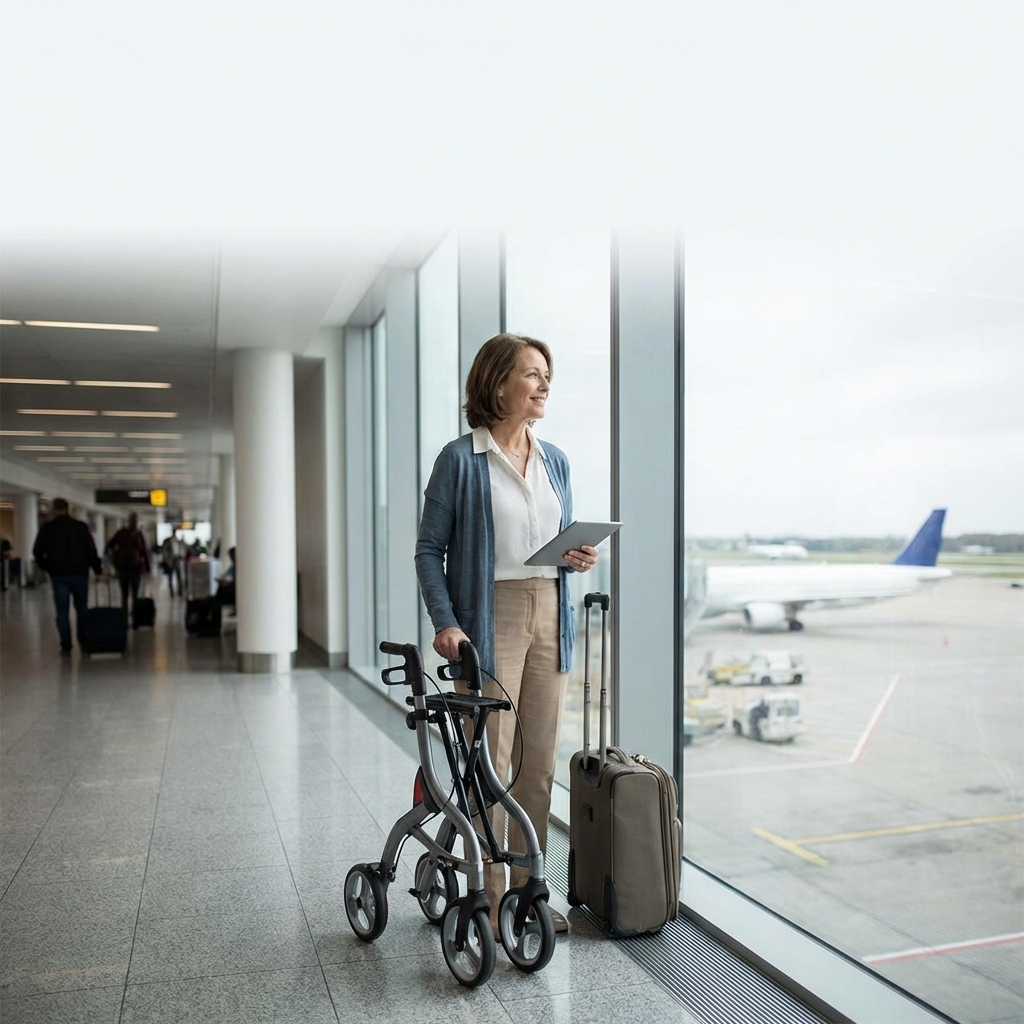
Whether you use a walker yourself or you’re traveling with an older parent, airports can feel like a lot: long distances, tight connections, fast-moving lines, and lots of “hurry up and wait.” The good news is that you don’t have to wing it. With a few calls, clear labels, and a simple plan for security and boarding, flying with a walker or other mobility aid can be much more predictable.
This guide is general, educational information—not legal advice—and airline procedures can vary. Think of it as a calm framework you can adapt: what to arrange before travel day, what screening and boarding often look like based on U.S. guidance, and how to protect your equipment (and your peace of mind) along the way.
What to arrange with your airline before travel day
When you’re flying with a walker, the biggest stress reducer is getting details in writing (or at least noted in the reservation) before you step into the terminal. If you can, choose flights that reduce pressure: nonstop over connections, and airports you know are manageable. Earlier flights can also mean fewer delays and more staff availability, but pick what works best for your energy and mobility needs.
Before travel day, contact the airline (by phone, chat, or accessibility desk if they have one) and ask specifically about:
- Wheelchair assistance: how to request it, where you’ll meet the attendant, and whether it can be set up for both departure and arrival.
- Your equipment type: walker, cane, rollator, or other mobility aid, and whether it folds. Ask how it’s typically handled at the gate and on the aircraft.
- Stowage or gate check: what the airline expects you to do at the gate, whether you can keep the aid to the aircraft door, and how it’s returned after landing.
- Connection help: if you have a layover, confirm that assistance can meet you between gates (and ask how to handle tight connections).
Also ask what documentation (if any) they recommend for mobility aids, and what the process is if something is damaged. You’re not expecting trouble—you’re just being prepared.
How screening and boarding often work (based on official guidance)
Airport security can feel intimidating, but you’re allowed to advocate for comfort and clarity. TSA publishes general guidance for travelers with medical conditions and mobility devices, and they also offer TSA Cares, a program you can contact ahead of time for assistance through the screening process.
What this can look like in real life: you arrive early, let the officer know you’re traveling with a mobility aid, and follow their directions for screening. Some mobility aids may need to be visually inspected, swabbed, or screened in a way that doesn’t require you to do anything unsafe. If standing without your device is difficult, say so plainly and ask what alternatives are available.
If you prefer more privacy, you can request private screening. It may take additional time, so build in a buffer—especially during spring and early-summer travel crowds.
For boarding and deplaning, it helps to coordinate with the gate agent early (not right as boarding starts). Let them know whether you’ll be using your walker down the jet bridge, whether you’re gate-checking it, and whether you’re waiting for assistance on arrival. Extra minutes up front can prevent that rushed, flustered feeling later.
Protecting your equipment during gate check or stowage
Even with the best staff and intentions, travel is hard on equipment. A few quick steps can make a big difference if your walker is gate-checked or handled separately.
- Label it clearly: name, phone number, and destination. Consider a luggage tag plus a taped card inside a fold if it has one.
- Take photos: a couple of quick pictures of the walker from multiple angles before you hand it over can help if you need to describe damage later.
- Remove what you can: baskets, cup holders, and other accessories are easier to carry on than to replace.
- Secure moving parts: if it folds, use a strap or fastener so it doesn’t spring open while being moved.
If something goes wrong, document it right away: take photos, keep baggage tags or claim checks, and report the issue to the airline promptly—ideally before you leave the airport area—so there’s a clear record of what happened and when.
A simple checklist for caregivers traveling with family
If you’re the “logistics person” in the family, your goal is to protect energy and dignity—yours and theirs. A short checklist helps you stay calm when the terminal is noisy and everyone’s hungry.
- Before booking: pick manageable connection times (or nonstop), and avoid ultra-tight layovers when possible.
- 48–72 hours ahead: confirm wheelchair assistance and meeting points; note the mobility aid type on the reservation.
- Day of: pack essentials in an easy-to-reach pouch (medications as directed by a clinician, snacks, water bottle after security, wipes, phone charger).
- At the terminal: ask, “Where will assistance meet us?” and “Where do we go after landing?”
- At the gate: confirm the plan for gate-check and return of the walker; ask who to speak to if it doesn’t come up promptly.
- On arrival: wait for assistance if needed, and don’t feel pressured to move faster than is safe.
Most of all, give yourself permission to slow the pace. A calm plan is a form of care.
Sources
Recommended sources to consult for current, official guidance (and to verify policy details for your specific trip). Airline procedures can vary by carrier and aircraft, so confirm directly with your airline in addition to reviewing these references.
- U.S. Department of Transportation (transportation.gov) — air travel accessibility rights and complaint pathways (verify current disability-related consumer protections and reporting steps).
- TSA (tsa.gov) — TSA screening mobility aids guidance and TSA Cares process (verify current contact methods and screening expectations).
- FAA (faa.gov) — general aviation safety information that may be relevant to onboard stowage constraints (verify any equipment-related limitations with your airline).